ruminous fee
ruminous fee
i have tried prudent planning long enough
from now on
insane

far away from home
once a city;
i turned into ruin

though
my essence flourished
by paying this ruinous fee
i have tried prudent planning long enough
from now on
insane
far away from home
once a city;
i turned into ruin
though
my essence flourished
by paying this ruinous fee
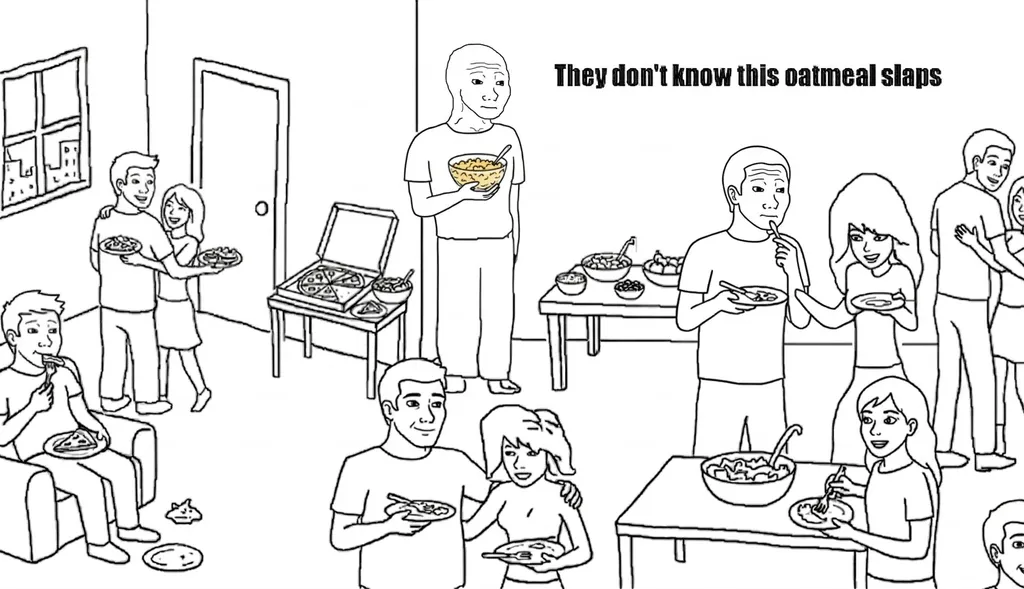
For me, eating oatmeal at lunch every day is almost a spiritual experience. Let me give you my rundown:
Healthy and cheap
Healthy, cheap and vegan. You can enrich it with bananas or goji berries for extra nutrients. You can use oat milk or other fluids that are enriched with stuff you might be lacking, like vitamin D and calcium.
Great and efficient routine
You have more time in the lunch break to do whatever. You can legitimately get down the ratio you like better each time you make it. If you skip breakfast, you are craving food by lunchtime1.
Tribal creatures we are, there is always an undercurrent of “what will my work colleagues think about this?” Doing it anyway builds genuine self-confidence. I also think it’s secretly high status: you open the door for your work mates to do similar weird shit at lunch.
It doesn’t even mean you eat worse overall. My work colleagues might doubt this, but I cook really nice dinners. Oatmeal at noon is what enables that, in a kabbalistic way I can’t describe.
Variety
I’ll try to describe the exoteric side anyway: if you constrain your life in one area, it opens up a lot of options in another area. If you constrain your sleeping and wake-up time, that’s the only real way to have a routine where you write each morning, or exercise each morning, or do whatever each morning. Variety comes from constraint.
You can min-max your oatmeal with whatever nutrition (and taste) you need, and can even do morphological analysis on your combinations:
| Fluid | Base oats | Topping 1 (fruit) | Topping 2 (seeds/nuts) | Topping 3 (extra) |
|---|---|---|---|---|
| Oat milk | Rolled oats | Blueberries | Chia seeds | Goji berries |
| Water | Instant oats | Banana | Flaxseed | Honey |
| Soy milk | Steel cut oats | Apple | Walnuts | Cinnamon |
| Coconut milk | Overnight oats | Mango | Almonds | Cocoa powder |
| Almond milk | Raspberries | Pumpkin seeds | Peanut butter | |
| Strawberries | Hemp seeds | Protein powder |
I swear, I genuinely feel people are missing out on the greatness of oatmeal at lunch.
The easiest way for us to gain happiness is to learn how to want the things we already have
~ William Irvine

International flights, connect me to the Wi-Fi
The only way you reach me, huh
~ Pusha T
Ozempic is the moment society stops pretending that discipline alone should govern the body.
If you take steroids you’re a loser — that’s the mood. It’s almost similar with Ozempic today1, but the mood is shifting.
From what we know, Ozempic is safe2, and people love it because of the upsides: improved health, looks. Downstream from that, confidence. Healthier, happier people lead to a healthier, happier society.
It follows that Ozempic won’t just make us healthier, it will change how we as a society think about external interventions into our bodies. I argue this shift will also lead to us becoming spiritually healthier, with the help of external devices.
There’s a growing literature on transcranial ultrasound neuromodulation, a noninvasive way to reach deep equanimity. You point ultrasound at specific brain regions, modulating neural activity toward equanimity, all without surgery. It’s a hot topic, soon you’ll hear all about these devices in societal discourse.
If you react with puritan disgust (why would anyone want help to meditate, this is backwards from its purpose), start observing how the mood around Ozempic changes in your society. Being overweight has huge effects on people’s lives, and by extension, society. Not being equanimous does too. You can almost run down the entire list of seven deadly sins: anger, envy, greed, pride — all failures of equanimity.
Within ten years, the idea that mental states must only be achieved through discipline will look as outdated as the idea that bodily weight loss should only come from discipline. Ozempic is just the first domino. I actually don’t know which intervention comes next, but they’re coming. All I know is that Ozempic’s success makes society change its mind.
A young man rushed to Nasreddin Hodja’s house, breathless and wide-eyed.
“Hodja, I have seen something extraordinary. A new kind of intelligence is coming into the world. Not from scholars, not from books, but conjured from algebra. This intelligence will be everywhere. Nothing will ever be the same.”
Nasreddin nodded slowly and sipped his chai.
“But Hodja, my friends won’t listen! I try to warn them, I try to explain, but they laugh at me. They don’t believe it. How do I make them understand?”
Nasreddin set down his cup.
“You say this thing will soon be everywhere?”
“Yes! Abundant. Unlimited. Like water from a spring.”
“Let me understand this,” said Nasreddin. “You say a great intelligence is spawning, almost like a djinn?”
“Greater than anything.”
“And yet you, a capable human, who has seen this, cannot convince a single friend?”
The young man blinked.
“Then you both are not so intelligent,” said Nasreddin, “or you are possessed by this. If this thing is truly as clever as you say, why doesn’t it do the convincing?”
In the theme of 2026 and new habits, here’s what worked for me: the no days off principle1.
Let’s say you want a good sleep rhythm, start exercising for reals this time, write more, etc. When dreaming up these habits, you automatically visualize the gold standard: the perfect 8-hour sleep, the unbelievably energizing exercise, the writing of exactly one hour in the morning, getting one article done per day. Ah, beautiful.
The flip side is that if you don’t achieve this dreamed up scenario, you feel bad and lose the habit. Also, because you have such a high expectation of the habit, you’re less likely to start. So in reality, the daily decision matrix looks like this:
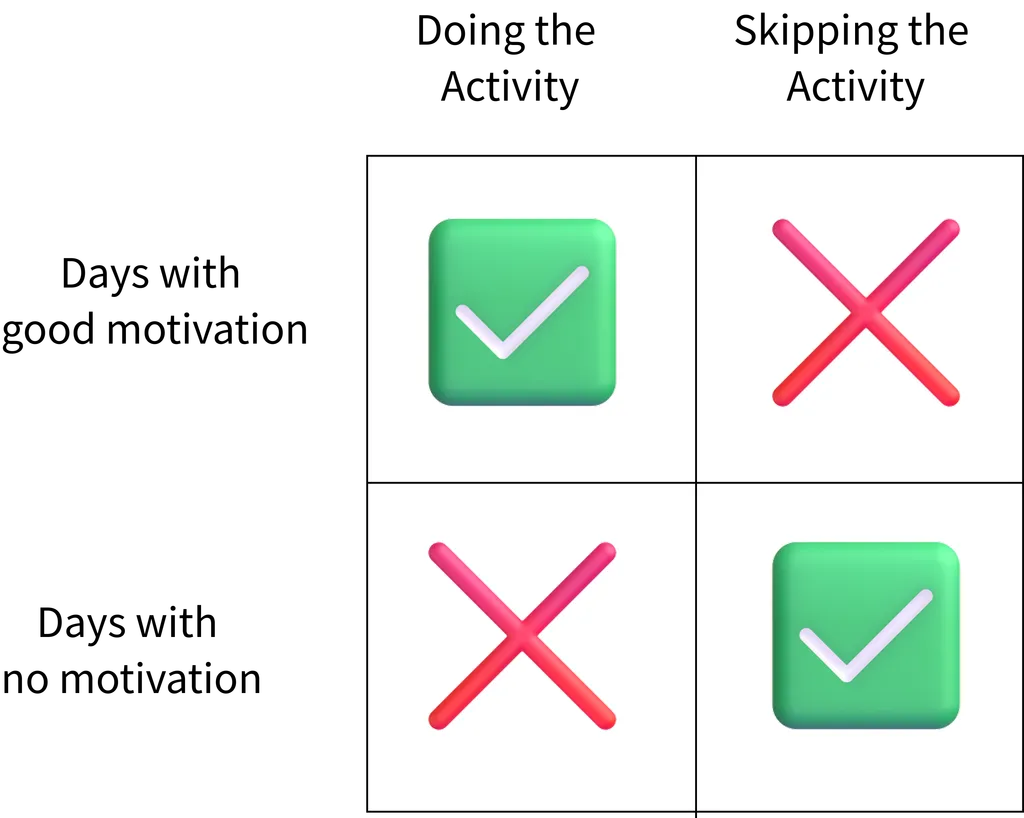
Skipping an activity you swore to do is such a normal thing that I don’t think I need to further explain the matrix and its implications. Some days, you skip the habit because of low motivation.
There’s a better way to frame the problem, in which skipping the habit is the ultimate enemy. This is the framing of the no days off principle — do a little even on days with no motivation. Here is the decision matrix with the new framing:
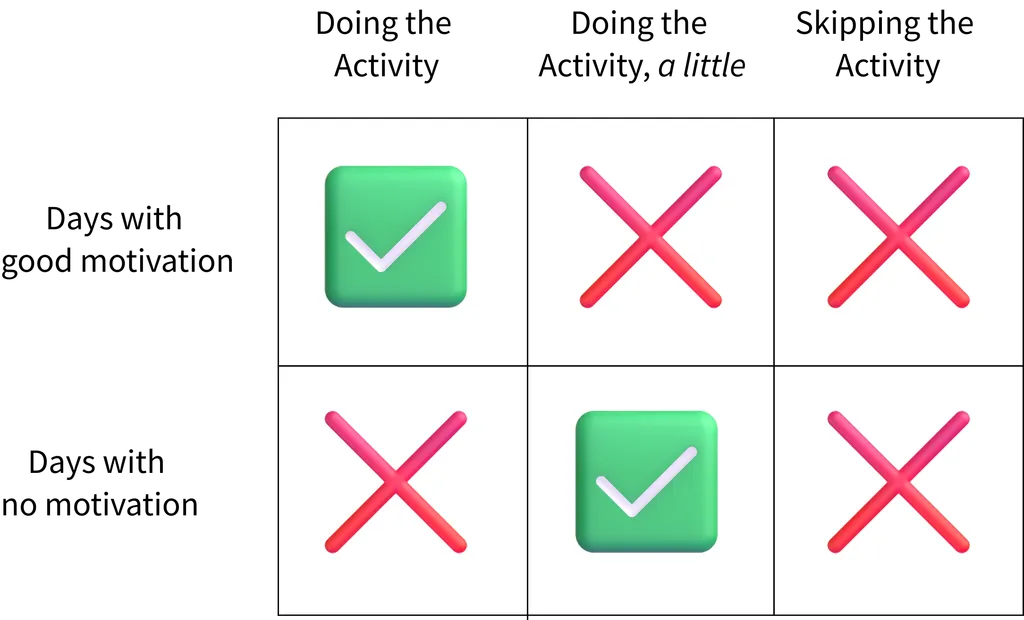
Let’s reframe the good sleep habit we want to achieve with this new matrix. The first insight is the trick of having good sleep is not really waking up early, but going to sleep early. But life happens, throughout the year you won’t always control when you sleep. You can, however, always wake up at 7am. So let’s reframe the habit to “Wake up at 7am each day”. Of course, of course, getting 7-8 hours of sleep is the gold standard. But! Internalize that the gold standard isn’t always possible, and skipping the habit is the enemy. So wake up at 7am, even if it means less sleep. In fact, we know that being regular in your sleep cycles might be more important than getting the perfect amount of sleep each night.
Reframing the other habits: exercise (a little) each day, write (a little) each day. That way you stay in motion, you beat the enemy. If you haven’t done exercise, just go out and do a little — just do some pushups, man, if you really have no time. You will notice that you will exercise more regularly, and once you started with just a few pushups, you’ll likely do more.
Instead of defining your habit goals as “exercise more” or “lose x amount of weight”, rather write them as doing something every day, and never stop. You also compound if you do it every day, and long-term, a little gain beats a loss. No excuses!
Why giving good universal advice can be bad or I wish I could pre-filter psychopaths
In person, I tune advice to whoever I’m talking to, as advice is context-dependent. On the internet, advice I give is more universal and boring, as context is scarce.
And even the universal, boring advice has exceptions. “Just talk up people on the street” is a potentially life-changing activity, unless you’re socially awkward and/or considered creepy-looking. If you are unable to walk, “Take a long walk to clear your head” is useless.
The above examples are mostly harmless offenses, though. There’s a worse category: advice that becomes dangerous in the wrong hands — a.k.a. psychopaths.
“Look up which conferences someone attends and show up, people love to hear you came for them” is good networking advice. “Be persistent about meeting them, sending multiple follow-ups if you must, it usually works for me” is great communication advice. Both tips become stalking instructions for a psychopath.
This is a genuine problem. I’ve heard podcasters say they never discuss stalkers on air. Psychopaths are mimetic—talking about psychopathic acts motivates them.
So adding “unless you’re a psychopath” to advice doesn’t help. Even worse, it invites the psychopath. So you’re left with two options: don’t give advice, or give it knowing the wrong person might take it to heart.
Related

If I’m leaving 2025 with any core reflection, it’s that I increasingly believe that the world has no place for those who lack conviction, that mistakes are forgiven while tameness is ignored, that perfection loses to done every time, that commitment and tenacity and audacity and self-promotion and risk-taking compound more than anything, and that all of this always starts with one very achievable next step that looks like a cliff but is much closer to the ground than you realize.

quit brainrot. unfollow trolls. read essays. go down rabbit holes. have a calendar. maintain a todo list. read old books. watch old movies. turn on dnd. walk with intent. eat without youtube. chew more. train without music. plan for 15 mins. execute. organise your desk. take something seriously. read ancient scripts. act fast. find bread. eat clean. journal. save a life. learn to code. read poetry. create art. stay composed. refine your speech. optimise for efficiency. act sincere. help people. be kind. stop doing things that waste your time. follow your intuition. craft reputation. learn persuasion. systemise your day (or don’t). write. write. write. write more. iterate violently. leave your phone at home. walk to the grocery store. talk to strangers. feed the dogs. visit bookstores. look for 1800s novels. experience art. then love. sit with a monk and offer them lunch. don’t talk shit about people. embody virtue. sit alone. do something with your life. what do you want to create? turn off your mind. play. play a sport. combat sports. notice fonts in trees. fall in love. notice patterns on a table. visualise it. talk to people with respect. don’t hate. be loving. be real. become yourself. cherrypick your qualities. discard the useless. rejections aren’t permanent. invite what aligns. accept what does not. read great people. be different. choose different. do great work. let it consume you. lose your mind. value your time. experience life.
I don’t want to come across as negative, though I know some posts might read that way. Here’s what happens when I ruminate: I notice patterns in myself and others, try to figure out what’s going on, then post about it. Any criticism applies to me first.
I am a victim of the Exemption Outsourcing Pattern, I tend to overcomplicate things, I like complaining about complainers. I want my posts to read as optimistic, that noticing and learning is powerful, that I can be self-aware enough to change my behavior, and thus change the world.
Just like “Make America Great Again” can be read as both pessimistic and optimistic, any criticism holds both challenge and invitation.
Two observations about how people interact with differing opinions they encounter:
Pick a subject, nearly any subject, and there will be people flipping out about differing opinions. Nothing new here, no need to elaborate.
What I find interesting is one subtle way this plays out online. A subtle enough pattern that it’s worth talking about. Let me illustrate the pattern with an example, starting with a person posting their opinion/observation online:
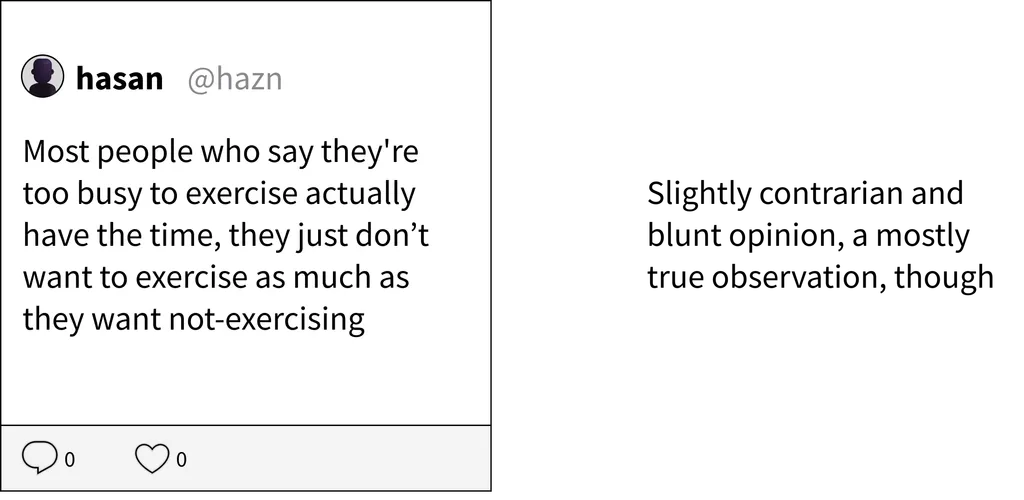
When people encounter something like this, a fork happens: some get offended, some don’t. Most non-offended people agree with the opinion or simply scroll past. It’s the offended people who are more likely to engage with the post. The offended can be split into two groups again:
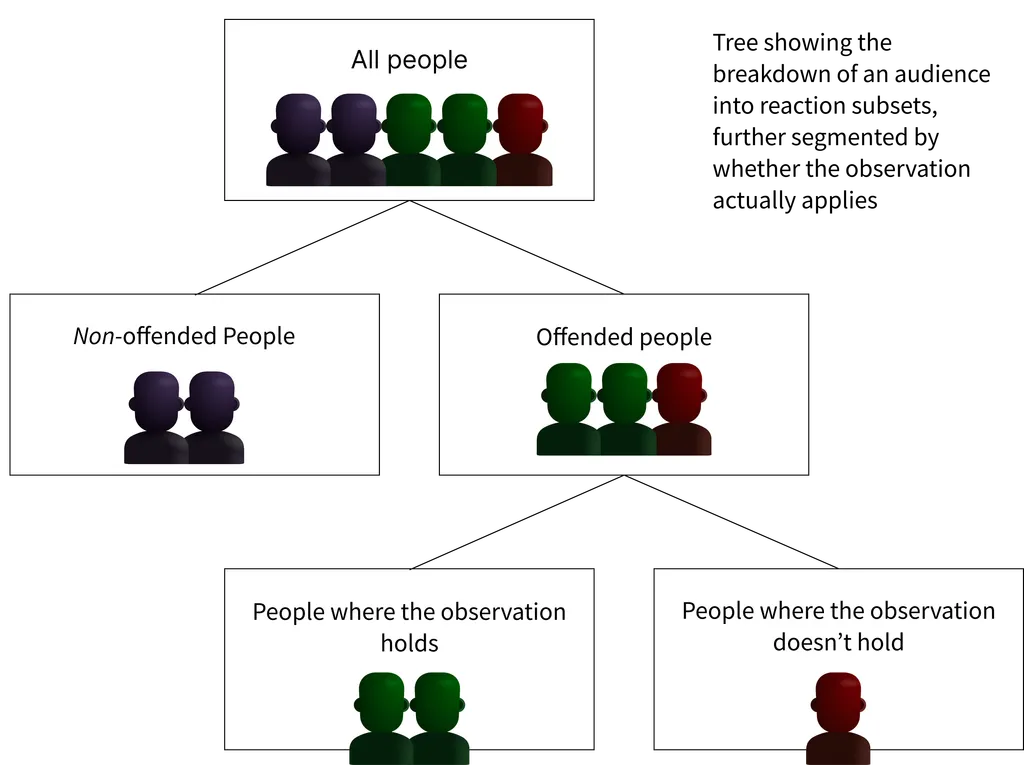
Here’s the part I find interesting: Someone from that small minority replies, explaining how the observation doesn’t apply to them. The majority, the ones it does apply to, then rally behind that reply/comment.
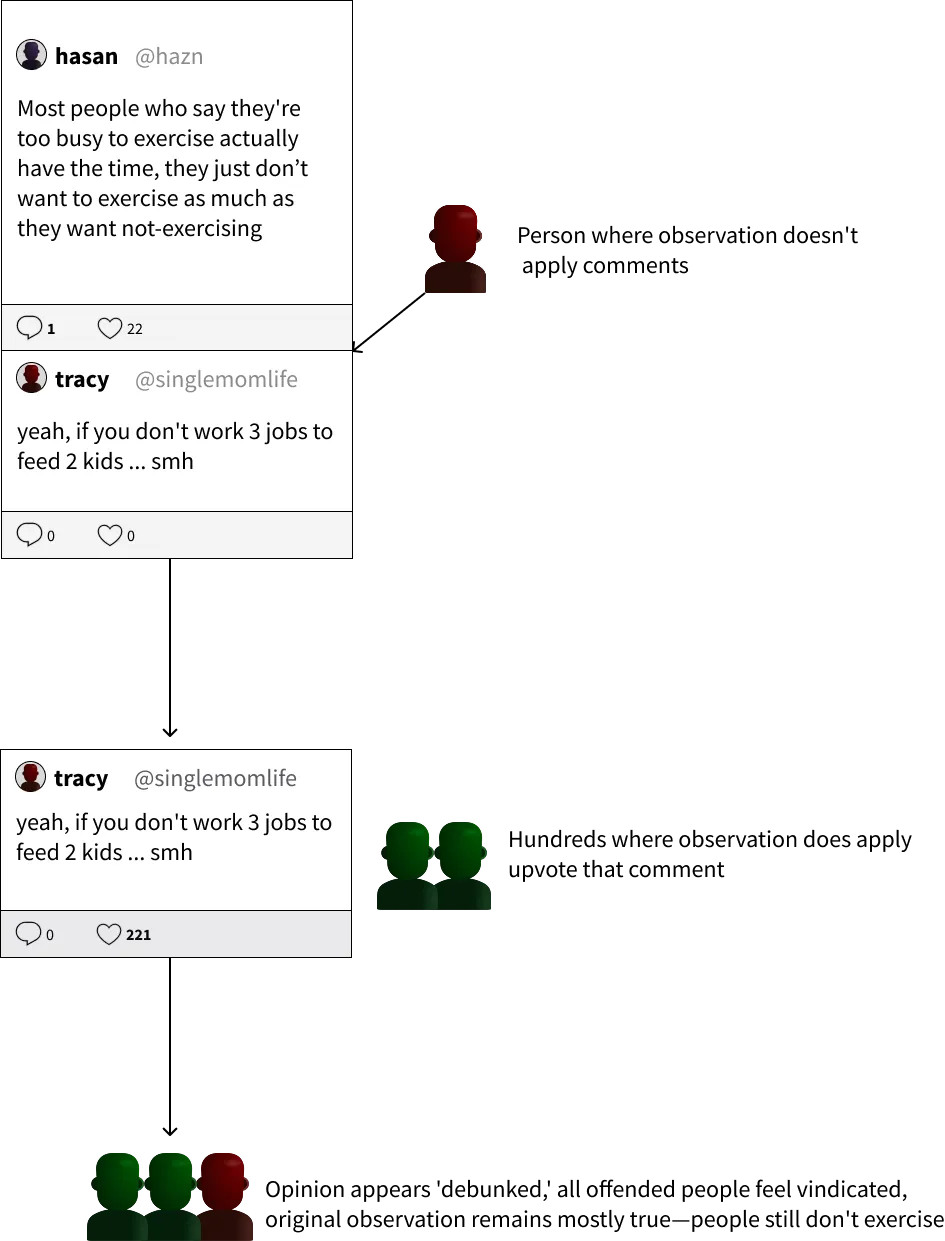
The majority latch onto the exception case that doesn’t apply to them. I call this pattern the Exemption Outsourcing Pattern. A pattern where people avoid being uncomfortable by hiding behind someone else’s valid exemption. This happens because dismissing the original opinion is cheaper than changing behavior.
Once you zoom out a little, you notice this pattern everywhere. Simpson’s paradox is an example from the statistics world. From the legal world there is the “Hard cases make bad law” concept.
A common social media trope is posting advice from people on their deathbed. Usually about things they didn’t do. “I should’ve been more there for my loved ones” is a classic tune, “I should’ve cared less about what other people think” is another hit, usually culminating in the banger conclusion of “I should’ve done [a super specific personal thing like opening up a hobbyist store or buying a house in their favorite hinterland].”
I don’t value this kind of advice much, it’s too cheap. Just like complaining is just so cheap. Maybe there are good reasons at the time to not tackle the thing they are regretting, or they were too whiny in the first place to do transformative things. I think that’s my biggest problem with deathbed regrets, it feels like time-travelled whining about your life situation.
When chronic whiners annoy you — those who love non-stop complaining more than solving — mention that their complaint just became a top deathbed regret candidate. Or you can be polite and internalize that you are probably gonna hear about the same person on their deathbed advising the exact opposite of what they’re doing now. That way you can be just like me and whine about other people’s whining.
So yeah I don’t value regrets packaged as advice, especially from people who never acted on their advice — a.k.a. people on their deathbed. “The uncaught fish is always a big fish” is the appropriate Turkish saying1 that captures my mood.
Better advice comes from things people actually did. This is fundamentally because advice doesn’t work that well, but being a role model does.
Anyway, “be less on social media” is another advice/regret I am sure will be on people’s lips on their deathbeds. I’m sure because I hear it a lot. People are aware of this regret pre-deathbed and free to act on it now. Or they can just post on social media about deathbed regrets.
Related
Two simple observations and my own two cents
Rational choice models of decision-making suggest gathering information on options and then proceeding with the option that best fits a person’s current preferences and values. Paul argues that such a decision-making process is not possible for some options, called “transformative experiences”, because the experience fundamentally transforms the person experiencing it. Paul offers a hypothetical example of a decision to become a vampire. Because a person would be fundamentally transformed by becoming a vampire, they cannot possibly know in advance what being a vampire is like. Other vampires might offer information, but their advice is likely shaped by their own irreversible choice. In this situation, a fully informed comparison of preferences and values is impossible.
~ Wikipedia summary of L. A. Paul’s “Transformative Experience”
Folks, you’ve heard it, evaluating too much doesn’t only lead to analysis paralysis, it also sometimes just isn’t possible . The question remains: why should you do something you can’t evaluate?
[Steven] Levitt invited individuals who couldn’t make up their minds about matters both major (like divorce) and minor (such as changing hair color) to avail themselves of a randomized coin toss.
...
Individuals whose virtual coin turned up heads were 25 percent more likely to make a change than those whose coin flip yielded tails. And, based on what they reported in two follow-up surveys over a six-month period, the nudge of a coin toss was just what these participants needed. Regardless of their responses to the coin tosses, participants who decided to make a change reported that they were substantially happier than those who did not.
~ Summary of Working Paper 22487, National Bureau of Economic Research
I have never ever regretted big life choices, even if they didn’t work out. Quitting a job with no money and no backup plan taught me a ton: I improved my network, learned how to ask for favors and introductions, and started to hustle. I learned I can go bankrupt and the value of social welfare systems. Next month I am joining a startup with all the responsibilities I wish I had in my previous job.
Let this post be the coin flip for your life choices.
The classic explanation of growing bureaucracy inside an organization is that the people who benefit from the processes (i.e., bureaucrats) have an interest in perpetuating the growth.
This is probably true, incentives are superpowers and all that. I’d like to add an often neglected point to the discussion: people who don’t benefit — who hate the bureaucratic processes — also push for more bureaucracy.
Here’s an analogy.
During the 2008 housing crisis, many Americans were furious that their neighbors might receive mortgage relief they themselves didn’t get. This resentment helped fuel the Tea Party movement. The same psychology applies elsewhere: “I had to work hard, why should others get UBI?” Or: “I suffered through a brutal exam, so future lawyers should too.” And it applies to bureaucratic processes too.
Being denied something by bureaucracy creates a kind of mini trauma, one that resurfaces when people see others slipping through gaps the bureaucracy hasn’t yet reached. The people then pressure the powers that be to close the gap, to formalize the exception, to make others suffer the same process.
Of course, there are legitimate reasons to formalize things. But we should also admit that ‘this isn’t fair to the group’ often masks ‘this isn’t fair to me’.
People flip out over rearranged or occupied desks at work. Someone moved their stapler, shifted their monitor, took their place, and suddenly it’s a whole thing. I, personally, can handle an occupied or rearranged desk. I flip out over rearranged apps.
Software usually comes with the “automatic update” setting on by default. You probably know what I’m going to advocate for. In my opinion, this setting should almost always be turned off.
Reasons against auto-update:
Of course, everything is a trade-off. One reason web applications are popular is because they basically force every user to auto-update.
Reasons for auto-update:
The security argument is strong, however, software providers pivoted to either using a different update channel for critical security fixes or they stop supporting vulnerable apps outright, which is sane behavior. In that sense, the “app version not supported” banner might be a good thing, heh.
The tradeoff is worth it in my eyes. Since turning auto-update off, I have more calm about my frequently-used apps and I don’t flip out about someone rearranging my apps.
Related
We fetishize time, let’s put it in a nice dress
Getting more done with less is knowing which tasks to delegate (to AI) and which tasks not to do at all. In other words, extreme clarity on the stuff you ought to do, and extreme focus while doing it. The most fundamental way I achieve clarity is by typing down everything, literally everything I do and think about. That’s a story for a longer post. This post isn’t about my typing tips; it’s a tribute to the timebox. And the focus you can achieve with ~dot~ it.
The gist of timeboxing is that you define a task time and set aside a limited amount of time to solve it. Here lies the first benefit of the timebox: actually thinking through what you want to do right now, and how long it should take. Just scribbling down things on the task at hand gets you much closer to working tidy. There are many posts and theories about maximum timebox efficiency, but I keep it lightweight.
I use Session as my timeboxing app of choice1. Mostly because when the timer for the timebox starts, there’s a delightful animation to guide your breath:
I just stare at the dot and breathe, in and out. I always go back to the dot. Don’t want to work? Go back to the dot. Stressed? Go back to the dot. Dot.
Wouldn’t you know, staring at dot is a quintessential meditative and concentration practice. My tip: while breathing in, suck in the upper part of your stomach. It automatically becomes a meditation practice and fixes your posture.
The dot clears the noise so you can actually attune.
After dotting around, I start defining the task. The first timebox timer is for always 5 minutes long in which I fill out the following text form:.
- What should I be doing now?
  - 🔵
- goal@🔵
- async task: 🔵

(hint: "🔵" is my way of marking text snippets as "to fill out")
The generation of the text form is automated. The filling out is not. Basically, I view it as a Socratic monologue with myself about what is currently the highest priority. Like, not what I think is the highest priority, but what actually is the highest priority. Small tasks like replying to messages are done instantly. The highest priority task crystallizes through asking and answering abstract questions, like “is there a better way to do this?”.
Having found the task, I timebox it, like goal@8:30 - ship article.
The async task field forces me to think about if I can use AI agents to aid me with the task, like doing research in parallel.
Here’s a filled out example from this morning:
- What should I be doing now?
  - Mhh, ship article? Or work on the app?
    - The app can wait, article is more important as I want to write everyday
  - Is there a more important task right now?
    - Nope, ship article
- goal@8:30 - ship article
- async task: Claude deep research breathing techniques
Usually I start working on the task before the 5 minutes are up. Then the 5 minute timer pops, I set the actual timebox for the defined goal, and keep going. When the timer runs out I take a break. The actual evaluation and reevaluation of the work happens after staring at the dot. Rinse and repeat.
I follow this order religiously: breathe first, then decide what to do, then timebox. When the timer dings, I stop. When I don’t follow the timebox and the dot, I have my least productive days. Most online productivity articles impose too much structure for my taste. My workflow is optimized for me, but the steps flow into each other naturally. No predefining of timeboxes and tasks.
Just asking what I should be doing, how long it should take, and what I can skip entirely. Over and over and over and over.
fin
dot