No days off
In the theme of 2026 and new habits, here’s what worked for me: the no days off principle1.
Let’s say you want a good sleep rhythm, start exercising for reals this time, write more, etc. When dreaming up these habits, you automatically visualize the gold standard: the perfect 8-hour sleep, the unbelievably energizing exercise, the writing of exactly one hour in the morning, getting one article done per day. Ah, beautiful.
The flip side is that if you don’t achieve this dreamed up scenario, you feel bad and lose the habit. Also, because you have such a high expectation of the habit, you’re less likely to start. So in reality, the daily decision matrix looks like this:
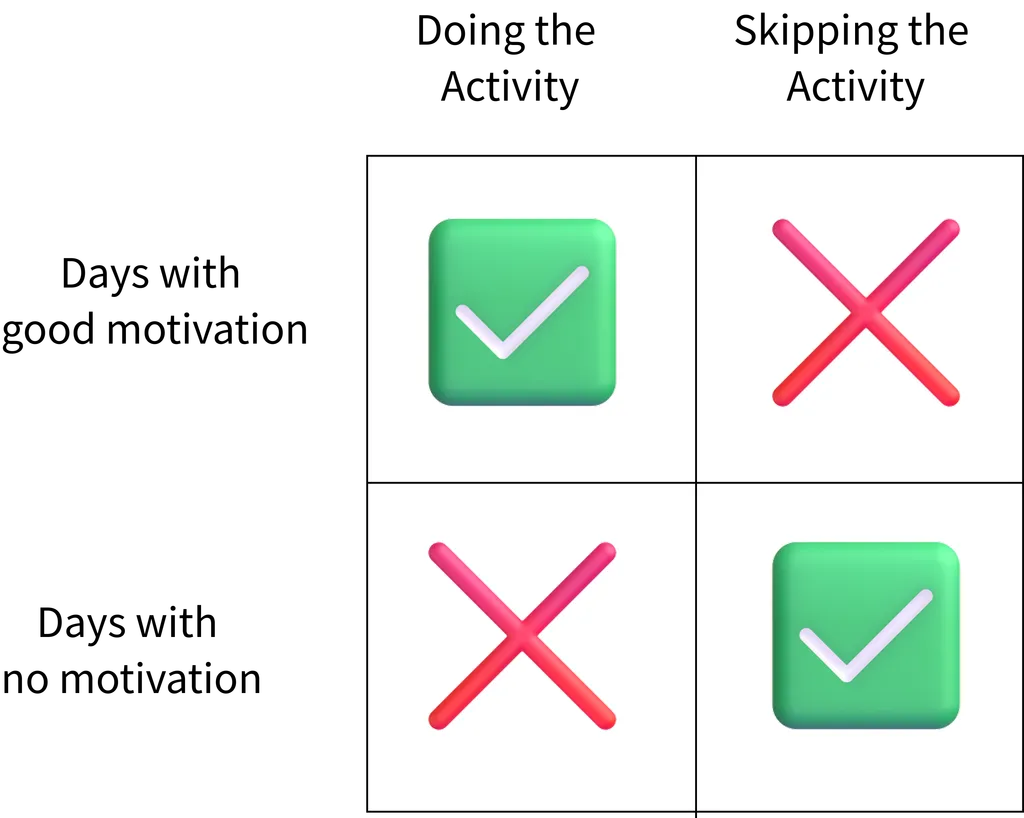
Skipping an activity you swore to do is such a normal thing that I don’t think I need to further explain the matrix and its implications. Some days, you skip the habit because of low motivation.
There’s a better way to frame the problem, in which skipping the habit is the ultimate enemy. This is the framing of the no days off principle — do a little even on days with no motivation. Here is the decision matrix with the new framing:
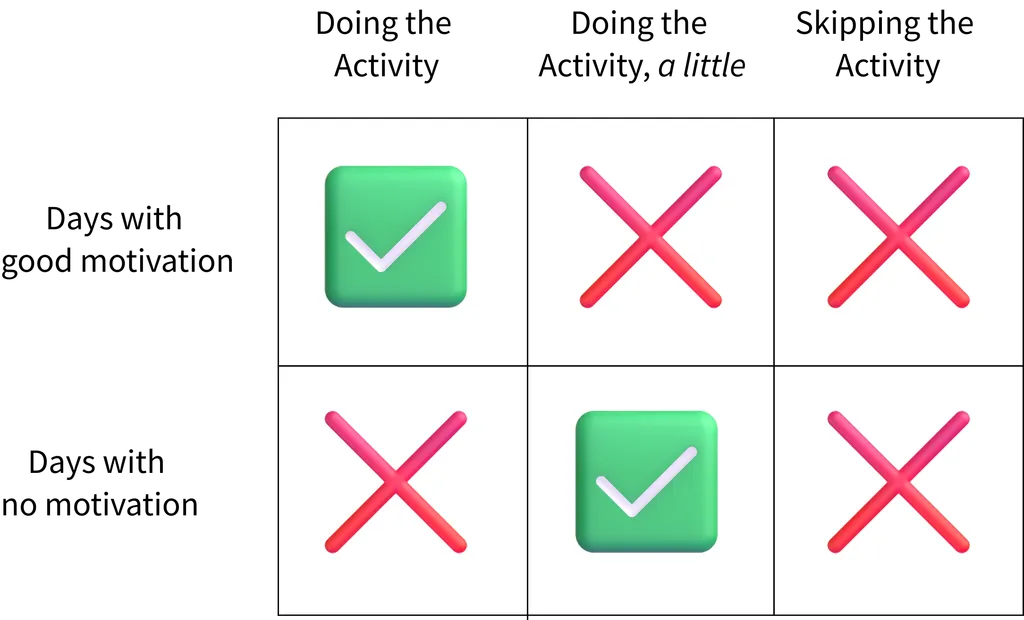
Let’s reframe the good sleep habit we want to achieve with this new matrix. The first insight is the trick of having good sleep is not really waking up early, but going to sleep early. But life happens, throughout the year you won’t always control when you sleep. You can, however, always wake up at 7am. So let’s reframe the habit to “Wake up at 7am each day”. Of course, of course, getting 7-8 hours of sleep is the gold standard. But! Internalize that the gold standard isn’t always possible, and skipping the habit is the enemy. So wake up at 7am, even if it means less sleep. In fact, we know that being regular in your sleep cycles might be more important than getting the perfect amount of sleep each night.
Reframing the other habits: exercise (a little) each day, write (a little) each day. That way you stay in motion, you beat the enemy. If you haven’t done exercise, just go out and do a little — just do some pushups, man, if you really have no time. You will notice that you will exercise more regularly, and once you started with just a few pushups, you’ll likely do more.
Instead of defining your habit goals as “exercise more” or “lose x amount of weight”, rather write them as doing something every day, and never stop. You also compound if you do it every day, and long-term, a little gain beats a loss. No excuses!
Footnotes:
- I am not sure if this principle applies to food, though. I still have one cheat day a week. This principle for habits that are an activity, not abstinence, at least in my experience. ↩